Wednesday, December 7, 2011

Gothic Architecture and the Culture that Propelled It


What is religion but a reflection of the society it is a part of? For thousands of years the Christian Church has been a dominating and prevailing function of society, but modern Christian churches are not built in the same style as they have been in the past. The architecture of the church changes with the tides of social revolution. An example: most Christians in Rome worshiped in their homes for fear of persecution, but when Christianity became the accepted religion, it became illegal to worship alone. This pattern of religious reform following social revolution prevails through the architectural styles: Classical, Byzantine, Romanesque, Gothic, Neo-Classical, Baroque, Rococo, and Neo-Gothic.[1] Though, there is a hiccup with this theory; there was no massive social revolution in the 12th to 14th centuries, but instead only small social winds of change as Europe moved from the middle ages towards the Renaissance. The period from the 12th century to the 14th century is seen as a transitory time and normally overlooked by the non-classical studies portion of society, so how did it produce the most recognizable style of religious architecture?

So how do we explain the linear relationship between society and its religion, and how does this relate to cathedrals? Before we can talk about architecture, it is important to understand the solidarity of the connection between religion and society.  All religions have two facets in common: adherents hold certain beliefs and certain rituals are collectively preformed based on those beliefs. Society, like religion, is a force larger than any individual and is depended on by everybody. In Christianity, the idea of God versus the Devil mirrors the dilemmas in society. The governments, economies, and social structures of the society collectively form the religion. For instance, tribal societies with weak political systems, simple economies, and have multiple gods, all of whom are roughly equal in power, and a malleable barrier between gods and humans. [2] In agrarian societies, the culture is built around agriculture, there is greater economic wealth compared to tribes, and women have a high status. Similarly, these cultures’ religions are built around female images and fertility rights, and have complex organization mimicking the complexity of agriculture. Empires tend to have powerful centers with numerous colonies and a distinct, complex division of labor. Their religions follow the same pattern. Take Rome, for example: you have Zeus as the powerful center and then lesser gods like Apollo and Aphrodite that are more numerous, have less power, and have a distinct reason for existing. Then we come to modern societies that are organized around the central political authority, which belies monotheism and the idea that one entity does everything and is everything. There is transition in this pattern as the majority of the world moves through these religious stages as society develops. What causes this change in religion? Society does, by slowly changing itself. If we describe societies by their characteristics, does it not made sense to describe religions by their monuments?

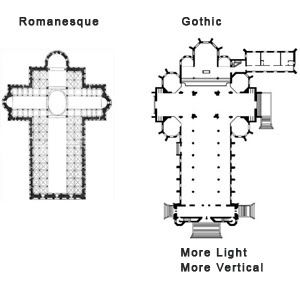
When people think of classic churches, massive towers, wide spaces, and arches come to mind, these are prominent features of gothic architecture. To understand why this evolution of style happened, it is important to have a basic understanding of what the differences are between Gothic and Romanesque. [3] While Romanesque cathedrals had small windows, round arches, thick walls, and were built to a modest height, Gothic cathedrals have large stained glass windows, pointed arches, exterior flying buttresses, and were built to soaring heights. These characteristics led Romanesque cathedrals to be dark and gloomy in comparison to the lofty, light filled Gothic cathedrals. Romanesque cathedrals had chapels and apses that were built in separate compartments in contrast to the unified, unbroken space of Gothic.[4]

So how did this transition take place? What allowed the architecture of the church to transform? First on the list is math and science: the ability to engineer the differences between Romanesque and Gothic cathedrals. The idea of supports and arches central to Gothic architecture came about due to an increased knowledge of physics as compared to the Romanesque period.
ß[5]  Flying buttresses are seen on all notable Gothic cathedrals, most notably on Notre Dame de Paris.  These are half arches that spring from the aisle walls to the ground with the purpose of supporting the weight of the vaulted, stone ceilings by transferring the lateral forces from the building to the ground.[6] The presence of these supports allowed the walls to be thinner because they no longer needed to withstand as much force. This allowed the use of more windows and more stained glass, which helped create the brighter, loftier characteristics of gothic architecture. One simple engineering idea alone revolutionized the ideas of what architects thought possible.

            Engineering was not the sole reason for this architectural revolution, however. As Edward Norman so eloquently points out, “gothic architecture is the style of emergent urban capitalism”.[7] While the main social groups at the time remained the royalty, the clergy, and everyone else, a new social group of merchants and independently rich was emerging. Everyone had a part in funding the construction of cathedrals be it though tithes or donations, but the emergence of this new group meant that around the 12th century, most of the work on Gothic cathedrals was not done by groups of people, but by experienced artisans called masters. In a nutshell, the emerging class had money, supplies, and expensive taste to donate to the church.


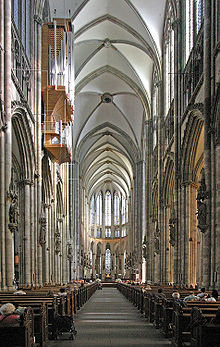
In the end, it all links back to the church. The Catholic Church at this point in time, the early 12th century, was stable with no threat of encroaching religions. Lutheranism had not yet entered the stage and would not be prevalent until the emergence of the printing press in the 16th century. Instead, Lutheranism, Calvinism, and the Antibaptists were part of the social revolution that led from Gothic to Neo-Classical. However, the tides of Christianity were changing. Simultaneously, a flood of social and economic improvement swept over Europe: people developed the willingness to try new ways of organization and were receptive to new ideas. Many did not believe that the whole of mankind could be damned, and there was new wind for a more personalized and intense religious experience. Prior to the 12th century, individuality was stressed. You worked on your own, for your own. Slowly the idea of de-distantiation crept into society.[8] This seemingly complicated word explains one idea, that the distance between the average day folk and the authorities was becoming [9]  smaller. This trend can be seen in Gothic architecture. Prior to the 12th century, the altar was placed at the end of the naves and represented the distance between man and God, as well as the sociological distance between man and government. Late medieval churches followed a different method that eventually led towards the spacious Gothic style.  Instead of the altar placed at the end of the naves, there were no naves and the church was instead one undivided hall in which the altar can be seen from every point.  The previous sense of awe towards religion and the government forged into a sense of solidarity and safety. While early medieval art depicted figures taken out of normal settings, late medieval art showed people in three-dimensional spaces with more illusionary characteristics.[10]

This brings up an interesting point; churches were no longer built to provide more room for worship, but were built as a testament to God in honor of the beliefs and aspirations of society.[11] Cathedrals represented every idea of the society and the engineering mastery of the time. The depictions on the walls, arches, and windows told stories of the glory of God. During this time period, the luxury of creating for the sake of beauty and wonder was allowed. This transitioned cathedrals from being simple places of worship to places that worshiped God themselves. Even empty, cathedrals stand as a testament to the power of God. They spread like wildfire. Churches all over Europe from the 12th to 15th centuries were replaced with Gothic styles, and astonishingly were all built in a similar manner showing amazing emulation between professional builders. Villages were throwing Gothic churches up like they were daisies.

This brings up an important question: how could so many villages afford expensive, intricate churches and cathedrals? This Gothic movement came to change the way people judged the prestige of towns, villages, and cities because only the best could afford the best craftsmen. Cathedrals were a source of prestige because of how long it took to create one, which could take up to one hundred years. This was not because of intense labor, but because of fluctuations in finances. The success of a cathedral became dependent on the expertise of balancing expenses, not just massive wealth.[12] Amiens managed to build one of the cathedrals most celebrated today, Notre Dame d’Amiens, while Cologne failed. This seems counterintuitive since Cologne was a larger, more prosperous city than the small village of Amiens. Amiens managed to beat out Cologne because they worked as a whole and managed their economy. Cathedrals were costly and time consuming and required a stable environment. Amiens provided this far better than Cologne.

So, imagine yourself walking up to a Catholic cathedral. From far away you can see the tall spires, which in actually had little use other than aesthetics.[13] Upon entering you walk through double doors into a holy sanctum. The light is limited, and while Gothic stained glass allows more light than Romanesque architecture, their main purpose is to depict and wow rather than let sunlight into the sanctum. At this point in time, early 12th century, there are not many benches to sit on; in fact the only ones in sight are made of stone for the use of the high clergy. The use of benches is a new idea and will not be used until into the 13th century and not common until the 15th and 16th with the Neo-Classic and Baroque style. [14] As you look around you notice the supports and arches. While looking at the supports you see leaves and plants etched into the decoration. Another idea new to the 13th century was extensive carvings of the earth symbolizing the ascent of life.[15] Finally, you may remain standing and take a moment of prayer.

Be it a visual journey through Gothic architecture, or the literate journey through the facets of the church, the church has much to offer. In a society where religion was prevalent, the emerging urban population and wealthy class threw their money into projects that soon defined the times. Cathedrals were not only a place of worship, but also symbols of religion. A proud society exiting the medieval ages was eager to replace old churches with new, luxurious examples of what they were capable of. This style of architecture spoke so loudly without ever saying a word that it became the standard, so much so that there was revival period during the 19th century. For a style that was not born out of political or religious strife, it has influenced how people think of cathedrals.


[1] J.B. O’Connell, Church Building and Furnishing: The Churches Way (Notre Dame:
   University of Notre Dame Press, 1956). 5.
[2] Randall Collins, Sociological Insight: An Introduction to Non-Obvious Sociology (New
  York: Oxford University Press, 1992). 30-60
[3] Carlo Trabia. Gothic and Romanesque, gif, http://www.bestofsicily.com/
[4] Paul Frankl, Gothic Architecture (London: Penguin Books, Ltd., 1962). 223-243.
[5] Corel Family. Gothic Church Diagram, gif, http://www.historylink101.com/
[6] Frankl, 86-89.
[7] Edward Norman, The House of God: Church Architecture, Style, and History (London:
   Thames and Hudson, Ltd., 1990). 147.
[8] Karl Manheim, Essays on the Sociology of Culture (London: Lowe and Brydone Printers,
   1956) 220-1.
[9] Unknown, jpeg, http://img.photobucket.com/albums/v487/blank14/Untitled-8copy.jpg
[10] Manheim, 224
[11] Norman, 150.
[12] Norman, 148.
[13] Gulielmus Durantis, The Symbolism of Churches and Church Ornaments (New York: AMS
   Press, 1973) cxxx-cxxxii.
[14] O’Donnell, 70.
[15] Norman, 162.

A Life Described by Movies


How do you summarize your life with one aspect of technology?           


           Transitions always seem to warp your perspective on time. While the transition of movie format from VHS to DVD and beyond was not a shellshock, newsworthy momentshock akin to 9/11, it still holds a valuable key in how children of the 1990s relate to the progress of technology. My own connection with movie platforms stems from my parents. While living in Dundee, Scotland during their university years, my parents would rent a movie and have a “date night in” every Friday night. This didn’t change even when my older brother and I came along. Every Friday once my brother finished school, my mother would take us to Blockbuster and let us loose. I would immediately run to my beloved Scooby-Doo, beg my mum to buy me a sweet, to which she always replied with a firm no, and then spend the evening in my parents’ room accompanied by Scooby and “those meddling kids”. 

          The concept of what I was watching Scooby-Doo never occurred to me until I was older. It was my brother who first introduced me to DVDs. In fact, he made fun of me for using video casettes because they were so old-fashioned and outdated. Mind you, this was close to the Millennium when DVDs were gaining more ground and we had just gotten a DVD player for Christmas. I, being a stubborn nine-year-old, stuck out my tongue and grabbed my good old video casettes. I only moved over to DVDs once Blockbuster stopped offering Scooby-Doo on VHS. The story of blu-ray is similar. Even to this day I don’t see what is so great about blu-ray despite the compliments my dad showers on it.

          Psychologists frequently point out hindsight bias, the tendency to go, Well, I knew that before you said it; I just forgot.” Similarly, I never noticed the quality difference between VHS and DVD until I had been watching DVDs for years. Now, I sit and look at the flat picture of video casettes compared to the more 3-D images of DVDs. I assume that this will also happen much more with Blu-Ray. Currently, I only notice that Blu-Ray is sharper than DVD, but I expect years from now I will be commenting on how flat DVD pictures look. This whole relationship is relatable to most aspects of technology. People now look at older cars and shake their heads, murmuring about chassis, motors, and cylinders. The same thing applies to chalk boards, white boards, clothing, music, and basically every aspect of human society. If our lives can be defined by one constantly changing aspect of human culture, the evolution of movies and my relationship with them defines my sense of self.

          The close relationship with movies that was fostered during my childhood radically changed how I perceive movies. While I have talked to some people that view movies as simple entertainment, movies, to me, mean bonding and consistency. A lot of the time I spent with my father while I grew older was spent watching movies because he didn’t know what to talk about with me. Watching a movie with my family meant we all calmed down, sat in one place, and spent a chunk of time together. Some people don’t see this as bonding because we would not talk, but just spending time in the same room with someone can be comforting.  Movies also gave me a sense of constancy and routine. Watching a movie every Friday was the first real routine I got into as a kid.

          This association with movies means I still look at movies fondly and seek out new ways to watch films. The way we watch movies has changed drastically over the years. My parents used to see movies mainly at the cinema in Scotland, whereas beforehand, you had to stand up and praise the Queen Mother. The main venue for watching movies that has changed along with movie formatting is movie platforms. While you could play a videocassette in any VCR, you still had to use a VCR. I remember when my brother got a Playstation 2 for Christmas. He loved it because he could play games on it. I loved it simply because I could watch Scooby-Doo while my parents were using the DVD player. It was the first dual-format gaming station I remember. Now, you can play DVDs on multiple gaming stations, not just the Playstation 2. My family doesn’t actually own a blu-ray player, simply because we have a Playstation 3 which carries the format for blu-ray. This made me think about our familys transition from physical to electronic.

          As I have stated, my family had the Blockbuster ritual. This ritual was slowly eclipsed by Netflix. When we first started using Netflix, you could get two movies at a time through the mail with free shipping, while paying one sum per month. For a while, Netflix supplemented Blockbuster, but eventually, with the combination of other options like virtual streaming, Blockbuster was out. It hit home when I saw the closing sign on my childhood Blockbuster. Now, Netflix not only ships movies to your house, but they offer instant movies through the internet and gaming consoles such at the Playstation 3. There is now no need to go out to get a movie. Redbox is a recent phenomenon, the final straw that pushed Blockbuster into bankruptcy. For Redbox, all you have to do is drive to a kiosk and look through the options on the screen. While Blockbuster made their money on late fees, Redbox only charges $1 for every 24 hours you have the movie. Not only is there the physical movie market, but with the growth of the internet, non-physical ways to watch movies boomed. There is an endless amount of websites that stream movies, although somewhat illegally. Hulu provides this option with no illegalities. They stream TV shows and movies for no fee, with the consequence of watching about four or five advertisements per hour.

          Overall, technology is predictable and will follow the same general trend. More ways of watching movies will develop, and more ways to obtain movies will develop. It is unlikely that many technologies will ever break out of this cycle. The question of whether or not we shape technology, or if technology shapes us, is confounding. Did movies create who I am today, or did I create that bond with movies on my own? Which one propelled the other? In this case, I would chance to say that movies created who I am; the technology created the culture. I say this because I was so young when I first started to watch movies and because I don’t remember enough concrete facts. For instance, I cannot say that music shaped my culture today, because music was never a big part of my childhood. At this point in time, my own cultural choices have shaped what music I do and do not listen to. Movies and I are too intertwined to separate like that. I recently had to answer the question, “What song describes your beliefs most?” Only while writing this paper did I realize that the song I chose was from a movie: The Lion King, to be exact. Did movies have such a profound impact on me as a child that my music taste today is influenced by the composers of those movies? Should I attribute my current preferences to the hidden stars of those movies? I lack the knowledge to decide this, but the idea fascinates me. My relationship with films is certainly an intertwined and undifferentiated part of who I am. 

Tuesday, November 15, 2011

Nonverbal Guide

Raven Jackson researched the changes in women’s underwear that occurred with during the nineteenth century. Underwear is the most intimate form of dress and has many meanings and connotations. The significance of underwear is not what it does, but what it means.

The changes in women’s underwear during the nineteenth century brought about changes in the social constructs regarding women’s sexuality. Underwear as we know it has only been around since the nineteenth century. Women wore plain, open- crotch underwear. With the advancements in textile technology brought about by the industrial revolution, women began to wear colored and adorned underwear that was meant to conceal and also show the area that it was concealing. The changes in women’s underwear that occurred during the nineteenth century made women’s sexuality more acceptable and acknowledged.

Resources:
1. Fields, J. "Erotic Modesty: (Ad)dressing Female Sexuality and Propriety in Open and Closed Drawers, USA, 1800–1930." Gender & History 14, no. 3 (November 2002): 492-515. History Reference Center, EBSCOhost (accessed September 29, 2011).
2. “Fashion,” http://library.thinkquest.org/C004179/fashion.htm.
Archive." Textile History 40, no. 2: 185-201. History Reference Center, EBSCOhost (accessed September 29, 2011).
3. Fields, Jill. "Drawers." In An Intimate Affair: women, lingerie, and sexuality. Berkley and Los Angeles, California: University of California Press, 2007.
4. Houlbrook, Matt. 2010. Desire: A History of European Sexuality. Victorian Studies. 53, no. 1: 183-185,193.
5. Storr, Merl. 2002. Classy Lingerie. Feminist Review. 18-36.
6. http://www.youtube.com/watch?v=U9eAiy0IGBI&feature=youtube_gdata_player


Eduardo Segura (Eddie) researched about sustainable architecture and the different possibilities to try to achieve the highest level of sustainability, using policies, different types of materials which have specific qualities in order to save energy and the construction of “intelligent buildings” to maximize the amount of energy saving.

All of theses different ways to get the sustainability are always developing itself by Technology and the changes made by these will be able to be perceived in the future because the problem of sustainability is a long term issue.


Resources:

1. Erenovable.com, renewable energy blog: http://erenovable.com/category/edificios-sostenibles/


2. Janda, Kathryn B, Buildings don’t use energy: people do,( Architectural Science Review, Mar2011, Vol. 54 Issue 1, p15-22, 8p, 1)

3. Peck, Martin, Strong, Long Lasting, Energy Efficient-Addressing Future Needs with Concrete, (Mar/Apr2010, Vol. 2010 Issue 2, p178-182, 5p)

4. Riekstins, Roberts, Architectural Shaping Potential in Energy Efficiency Provision of Buildings, (Architecture & Urban Planning, 2010, Issue 4, p100-105, 6p)


5. Green Buildings can save energy http://www.youtube.com/watch?v=jzc79N9WfuY&feature=related

6. Building energy savings, http://www.youtube.com/watch?v=O5lMAe0WF0w&feature=related


Maria D Silva’s research paper was about music as a form of nonverbal communication. Traces of music have been found from prehistoric time, where humans imitated natural sounds with percussion instruments. As Victor Hugo said “Music expresses that which cannot be put into words and cannot remain silent.” Since the prehistoric times music has been evolving due to technological changes. There are several examples of music genders that portrays it as a form of communication. One of them is classical music, specifically piano where composers tend to express their feelings through different sonatas. Even though Djs use completely different devices, they still maintain the essence of music, which states that it is not solely a form of entertainment but a complex form of communication.


Resources
1. Mark Katz, Capturing sound: How technology has changed music. California: The Regents of the University of California, 2004.

2. Terence McLaughlin, Music and Communication. London: Faber and Faber, 1970.

3.“The importance of communication in music: Interview of Kirk Whalum”
http://www.artistshousemusic.org/videos/the+importance+of+communication+in+music (Accessed on 10/13/2011)

4. “Roberto Spano on music as philosophy”
http://www.youtube.com/watch?v=t-MLUgFHbrA
Accessed on 11/10/2011

5. On music and non-verbal communication with Naomi Bell.
http://musicianintheboardroom.com/2011/10/23/on-music-non-verbal-communication-with-naomi-bell/
Accessed on 11/10/2011


Jennifer Rattray researched church architecture and how it changed as society changed. She focused on Gothic architecture which started in the early 12th century and is seen as the most recognizable form of religious architecture. The social, scientific, and economical changes during this period reflect a change in society that directly correlates with the change from Romanesque to Gothic styles. So how is this nonverbal communication? It is easy to see that art is nonverbal communication because it conveys emotions and stories to people by use of their eyes. Architecture is similar in this sense. Imagine yourself a serf, what would looking at a Gothic cathedral tell you. Would the tall spires intimidate you? What would you think of the massive flying buttresses? What could you infer from the massive stained glass windows?

Resources

Collins, Randall. Sociological Insight: An Introduction to Non-Obvious Sociology.
New York: Oxford University Press, 1992.

Corel Family. Gothic Church Diagram. Gif, http://www.historylink101.com/lessons/
art_history_lessons/ma/gothic_church_digram.gif (accessed November 6th,
2011)

Durantis, Gulielmus. The Symbolism of Churches and Church Ornaments, trans. Rev.
John Neale and Rev. Benjamin Webb. New York: AMS Press. 1973.

Frankl, Paul. Gothic Architecture. London: Penguin Books, Ltd. 1962.

Mannheim, Karl. Essays on the Sociology of Culture. London: Lowe & Brydone
Printers. 1956.

Norman, Edward. The House of God: Church Architecture, Style, and History.
London: Thames and Hudson, Ltd. 1990.

O’Donnell, J. B.. Church Building and Furnishing: The Churches Way. Notre Dame:
University of Notre Dame Press. 1956.

Trabia, Carlo. Gothic and Romanesque, gif, http://www.bestofsicily.com/mag/
art193b.gif (accessed November 6th, 2011)

Unknown. Untitled, jpeg, http://img.photobucket.com/albums/v487/blank14/
Untitled-8copy.jpg (Accessed November 9th, 2011)


Ishita Bose wrote about the art of photography and the invention of the camera and how it has affected nonverbal communication over time. Before photographs existed, paintings and sculptures were the main method of recording visual representations of people and events. However, these were not necessarily accurate since the idea of a perfect portrait was to emphasize the inner essence of a person, leading portraits to to depict people in good taste rather than how they actually were. Photography allows audiences to see a scene or person exactly how the photographer sees it. Using certain techniques and methods, such as poses or lighting, photographers evoke emotions and covey messages through their work.

Resources
1. Crews, Austin. “Communicating through Photography.” Human Communication Theory, University of Colorado at Boulder. (accessed November 8, 2011).

2. Rosenblum, Naomi. A World History of Photography. New York: Abbeville Press Publishers, 2007.

3. Welling, William. Photography in America: The Formative Years, 1839-1900 – A Documentary History. Crowell, 1978.